

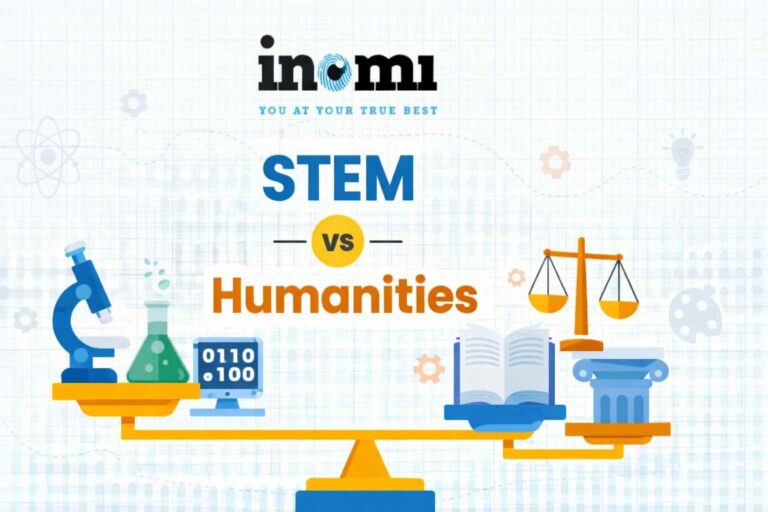
For years, students and parents have been presented with a rigid choice: STEM or Humanities. In India, especially, this decision often feels laden with expectations surrounding job security, social status, and long-term stability. So, how to decide between STEM vs Humanities? Let’s dig in deeper.
STEM vs Humanities: Moving Beyond the False Divide
Students are usually pushed to choose based on the social status associated with the STEM field or the job security offered within the field, versus the less predictably secure, secondary route of the Liberal Arts/Humanities. By framing the STEM fields and jobs as the only “future-proof” occupations, the Humanities are often relegated to the list of risky alternatives.
Yet this dichotomy ignores many critical aspects associated with either option; STEM provides technical logic and empirical data necessary to create and build the physical and digital infrastructure of society, while Humanities provides an essential lens by which people comprehend how their actions impact others and what it means to behave ethically and/or morally (in part).
In order for any society to be functional, an equal partnership between STEM and Humanities is required because technical innovation without any form of historical or philosophical context is ineffective in directing the growth of human-centric studies.
Related Articles:
STEM Isn’t Just for Science Students Anymore
Best STEM Majors for Non-Science Students: Top Options & Career Paths
Top Future-Proof Careers and How to Choose the Right Career
STEM vs Liberal Arts and Humanities: It’s Not About Difficulty, It’s About Perspective
That STEM is harder or more valuable than the humanities is one of the longest-standing misconceptions. The actual differences between the two disciplines are not in terms of rigor, but rather in terms of approach. STEM is based upon the principles of accuracy, technical solution, and precision. In contrast, humanities include the interpretation, context, human impact, and ethics.
Both disciplines require a great deal of discipline, depth, and intellectual effort. A mathematical equation in physics requires different types of problem-solving skills than a philosophical argument; however, neither is necessarily more difficult than the other.
When we find ourselves looking at challenges in the world like climate change, artificial intelligence, public health, and governance, it becomes apparent that solely technical solutions will not provide complete solutions. The use of human judgment, ethics, communication, and cultural understanding also contributes to the solution development process.
The interdependence of these elements within our world can already be seen in the way that technology influences society and society influences the development and use of technology. Progress is driven by the integration of both the technical and human components of the problem-solving processes. The solution is not to choose one component over the other, but rather to work collaboratively.
STEM vs Humanities: Why This Choice Feels Especially Hard (or Tricky) for Indian Families
Traditionally, in India, families have placed great importance on pursuing a STEM career above all else. In many ways, engineering, medicine, and technology provide family members (or their descendants) with security, opportunities to travel abroad, and clearly defined career paths, thus creating confidence that these professions provide a secure future.
Changing Trends and Mindset Shifts
With the change of a global economy in recent years, we can now see that key leadership skills (innovation, entrepreneurship, policy-making, or management) do not require a background in a traditional STEM area. Many of today’s top executives (from Fortune 500) hold advanced degrees from liberal arts/humanities programs, indicating that this type of education creates opportunities for individuals to become successful leaders and influence society in positive ways.
Parents and students can often find themselves struggling to adjust to the new realities of employability in the modern workplace. Students may feel free to think outside the box; however, it is difficult to make the transition from being told where you will go to being able to choose your own path. What is important to understand is that employability today is determined not only by what you study but also by how you think, learn, and adapt.
What STEM Truly Offers Students
Students who receive STEM training will find themselves with strong technical skills and clear pathways into careers, such as Engineering, Computer Science, Analytics, Healthcare, and Biotechnology, which are all industries that are currently experiencing high demand in India, as well as throughout the world.
STEM Advantages
Careers in these areas usually come with larger starting salaries, clearly structured job descriptions, and measurable opportunities for career advancement. Students who enjoy being logical, experimenting with their ideas, working within a structured environment, and solving problems through experimentation usually find that STEM provides them with a sense of comfort and security.
Several students have also expressed the need for clear outlines of their career paths (especially if they are considering studying abroad), as they leave high school and move into college, and prepare to establish a career.
Parents who are considering the potential for future earnings based upon their child’s education often find comfort in knowing that STEM degree programs have a strong connection to the skill shortages that exist globally. When paired with curiosity, constant learning, and continuous improvement, STEM provides stability and growth through the development of an innovative work environment.
What Humanities and Liberal Arts Bring to the Table
The arts and humanities equip people with a wealth of transferable skill sets into the future (highly employable). Critical thinking, effective communication practices, creativity, the capacity for empathizing & understanding others’ perspectives, seeing complex issues from different angles, etc., are among the essential skill sets used in careers such as law, business, consulting, public policy, media/journalism, education, psychology, and entrepreneurship.
Related Articles:
Decoding admissions to India’s top Liberal Arts Universities
Your Guide to Entrance Tests for Indian Liberal Arts Colleges
10 Best Liberal Arts Colleges in India
Advantage of Arts & Humanities
The greatest advantage of the arts and humanities is an immense amount of flexibility. Graduates of these programs are not constrained to a particular profession. Rather, they typically move through various fields, continue their studies by enrolling in cross-disciplinary master’s degree programs, or participate in producing something new by blending their respective backgrounds with technology or data.
For individuals who enjoy having discussions with others about differing viewpoints and opinions and who love reading, writing, and pursuing higher-level analysis of ideas, the arts and humanities provide students with both intellectual freedom and opportunities for individual growth. They prepare graduates to obtain their first position and for subsequent careers that may evolve throughout their lives.
STEM vs Humanities: A Practical Comparison
| Aspect | STEM | Humanities |
|---|---|---|
| Primary Focus | Technical systems and problem-solving | Human behavior, culture, and ideas |
| Learning Style | Structured, data-driven | Discussion-based, interpretive |
| Typical Careers | Engineering, tech, healthcare | Law, policy, business, media |
| Core Skills | Technical, analytical, quantitative | Communication, critical thinking |
| Career Flexibility | Specialized pathways | Broad and adaptable pathways |
| Indian Perception | Traditionally safe and prestigious | Growing global acceptance |
How Students and Parents Can Make a Thoughtful Choice
When it comes to choosing a major, asking which one is better isn’t as useful as knowing what type of learning will work best for the student. As students decide on a major, they need to keep in mind the things that really interest them while in classes—not just the classes where they get the highest grades. For example, do they prefer right answers or open-ended questions? Structured problem-solving or collaborative brainstorming?
Another thing to keep in mind is that students’ choices today are not solidified forever; many colleges now offer options to create double majors, minors, and cross-disciplinary programs (those combining STEM fields and humanities). For example, economics can be added to data science—psychology can be studied along with neuroscience—and technology can be taken with ethics and policy.
Students who follow their real interests and allow their curiosity to drive what they study will likely experience the best results; as students gain more confidence, they will become better learners and will ultimately have great success both academically and professionally.
Final Thoughts on STEM vs Humanities
Choosing between STEM and Humanities is not about prestige or fear. It is about understanding how you want to engage with the world. Whether students build systems, analyze societies, or bridge both, education works best when it aligns with who they are and how they think.
If you need guidance in making the right academic choices, explore our Career Counselling Services or Contact Us to speak with an expert.
Acknowledgment: This article has been co-authored and edited by Tanmoy Ray!
About The Author